
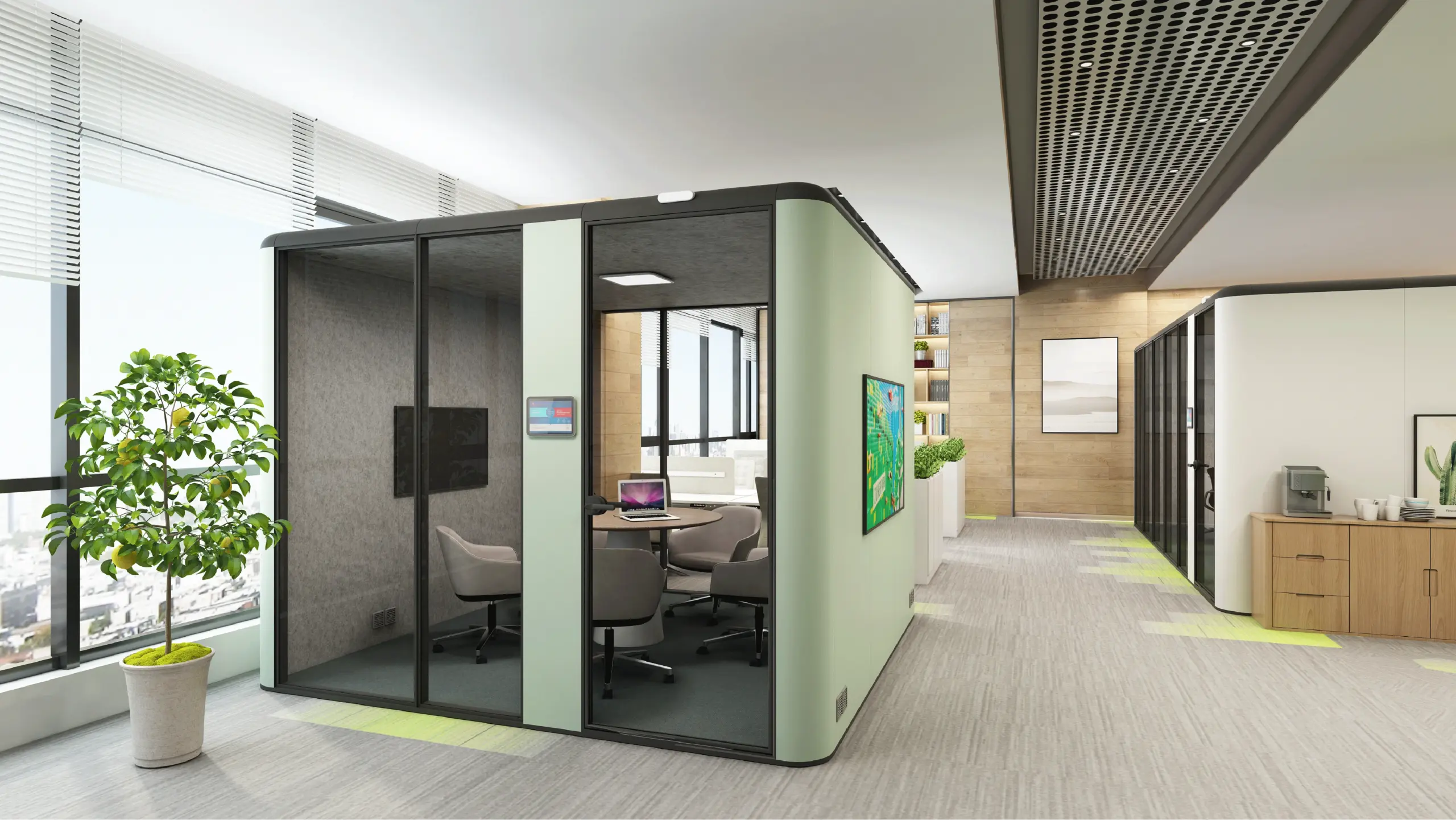
Introduction
When planning a new office, most companies focus on one question:
“How much will the fit-out cost?”
Unfortunately, that’s often the wrong question.
The real cost of an office isn’t measured on the day construction finishes—it’s measured over the next 5, 10, or even 15 years.
Every office eventually requires layout changes, departmental expansion, equipment upgrades, relocation, or refurbishment. With a traditional fit-out, each of these changes often means demolition, reconstruction, new materials, additional labor, and weeks of business disruption.
A modular office fit-out works differently. Instead of treating office construction as a one-time project, it treats the workspace as a flexible asset that can evolve with the business.
To illustrate the difference, we analyzed the 10-year life cycle costs of a 1,000 sq.m office in the U.S. market, comparing a traditional office renovation with Cheer Me room in room cube MX Modular Fit-out System using the same project assumptions throughout the study. The results show that modular construction doesn’t simply reduce construction time—it fundamentally changes the economics of office space.
Why Initial Construction Cost Doesn’t Tell the Whole Story
Many companies compare contractors based solely on their initial quotation.
However, the upfront construction budget represents only one portion of an office’s total cost.
During a typical lease cycle, businesses frequently encounter expenses such as:
- Office expansion
- Department reorganization
- Employee growth
- Interior refurbishment
- Relocation
- Construction waste disposal
- Business interruption
- Annual maintenance
These recurring costs are often ignored during procurement but become increasingly significant over time.
For our analysis, all calculations were based on a consistent benchmark:
- Office area: 1,000 sq.m
- MX modular system price: CNY 3,000/sq.m
- Lifecycle: 10 years
- Exchange rate: 1 USD = 6.7878 CNY
Using identical assumptions allows an objective comparison between traditional construction and a modular office system.
Construction Speed: A Faster Office Means Faster Business
Construction time directly affects when employees can begin working, when rental income starts, and how much disruption a company experiences.
For a conventional office renovation in the U.S., typical project duration are:
| Traditional Renovation | Typical Timeline |
| Basic refresh | 8–12 weeks |
| Medium renovation | 12–16 weeks |
| Premium remodel | 16–24 weeks |
Once design, permitting, and approvals are included, the overall project usually requires 3–7 months.
By comparison, Cheer Me room in room cube MX Modular Fit-out System requires only 2–4 weeks for the initial installation, improving construction efficiency by approximately 60%–80%.
Even more impressive is what happens later.
Instead of weeks of demolition, future office layout adjustments can typically be completed within 1–3 days, allowing companies to reconfigure work spaces with minimal interruption.
For growing businesses, that flexibility becomes increasingly valuable every year.
Initial Investment: Is Modular Really More Expensive?
Many decision-makers assume modular offices require a larger initial investment.
Our analysis suggests otherwise.
For a 1,000 sq.m office:
| Fit-out Type | Initial Cost |
| Economy Traditional | CNY 5,430,000 |
| Mid-range Traditional | CNY 7,800,000 |
| Premium Traditional | CNY 10,180,000 |
| MX Modular System | CNY 3,000,000 |
Compared with traditional construction, the MX system reduces the initial investment by:
- CNY 2.43 millionversus economy-grade fit-outs
- CNY 4.8 millionversus mid-range projects
- CNY 7.18 millionversus premium renovations
Lower capital expenditure also improves project cash flow, making modular offices particularly attractive for multinational companies, landlords, and fast-growing businesses.
Labor Costs Continue Long After Construction Ends
Labor is one of the largest cost drivers in any office renovation.
Traditional office construction relies heavily on on-site trades throughout every renovation cycle.
Typical labor represents:
- 40–50%of basic renovation costs
- 50–60%of medium renovations
- 60–75%of premium projects
Cheer Me room in room meeting cube MX Modular Fit-out System significantly reduces on-site work by using factory-manufactured components.
Labor accounts for only 20–30% of the total project cost, with most labor concentrated during the initial installation.
Future layout modifications require only minor assembly work instead of demolition and reconstruction.
This creates more predictable project budgets while reducing exposure to rising labor costs.
Construction Waste Is an Overlooked Cost
Traditional office renovations generate considerable construction waste.
Every renovation typically involves removing drywall, ceilings, flooring, partitions, and finishing materials.
For our 10-year office scenario, two renovation cycles generated:
- CNY 108,000in construction waste disposal fees
- Approximately CNY 54,000per complete waste removal
The study also notes that disposal costs in major U.S. cities may increase by 20%–30%, placing additional pressure on long-term operating budgets.
In contrast, Cheer Me room in room meeting cube MX Modular Fit-out System generates zero demolition waste.
Because walls, partitions, and structural components are detachable and reusable, no construction debris is produced during layout changes.
Besides lowering operating costs, this supports ESG initiatives and sustainable building strategies.
The Real Difference Appears Over 10 Years
The strongest advantage of modular construction becomes apparent when evaluating the complete office life cycle.
For a typical mid-range traditional office renovation, the 10-year cost reaches CNY 19,928,000, including:
- Initial fit-out: CNY 7,800,000
- Renovation in Year 5: CNY 5,460,000
- Renovation in Year 8: CNY 4,680,000
- Waste disposal: CNY 108,000
- Maintenance: CNY 780,000
- Business downtime: CNY 1,200,000
Cheer Me room in room MX Modular Fit-out System tells a very different story.
Its total 10-year life cycle cost is only CNY 2,850,000, consisting of:
- Initial procurement: CNY 3,000,000
- Three layout adjustments: CNY 150,000
- Relocation and transportation: CNY 100,000
- Maintenance: CNY 300,000
- Downtime during restructuring: CNY 150,000
- Residual asset value credit: –CNY 750,000
Unlike conventional construction, modular components retain value after years of use. Aluminum alloy frames can be recovered and reused, creating a residual value equal to approximately 25% of the original investment.
Traditional drywall and fixed partitions, by comparison, generally have no recoverable value.
Total Cost Comparison Over 10 Years
The financial difference becomes striking.
| Traditional Fit-out | 10-Year Cost | MX Modular | Savings | Savings Rate |
| Economy Grade | CNY 14.2M | CNY 2.85M | CNY 11.35M | 79.9% |
| Mid-range | CNY 19.928M | CNY 2.85M | CNY 17.078M | 85.7% |
| Premium | CNY 25.6M | CNY 2.85M | CNY 22.75M | 88.9% |
For the most common mid-range office project, companies save over CNY 17 million during a single 10-year life cycle.
Where Do These Savings Come From?
Rather than relying on one cost category, the MX Modular Fit-out System delivers savings across the entire office life cycle.
For the mid-range benchmark:
- CNY 4.8 millionsaved on initial construction
- CNY 10.14 millionsaved by eliminating secondary and tertiary renovations
- CNY 108,000saved in waste disposal fees
- CNY 1.05 millionsaved through reduced business interruption
- CNY 750,000recovered through residual asset value
Together, these advantages transform office construction from a recurring expense into a reusable business asset.
Which Businesses Benefit Most from Modular Offices?
MX Modular Fit-out is particularly suitable for organizations that expect frequent workplace changes, including:
- Corporate headquarters
- Technology companies
- Multinational enterprises
- R&D centers
- Shared offices and co-working spaces
- Companies expanding rapidly
- Businesses planning future relocation
Whenever office layouts are expected to evolve, modular construction offers significant financial and operational advantages.
Final Thoughts
Choosing an office fit-out is no longer just about construction—it is about long-term business performance.
Our 10-year life cycle analysis of a 1,000 sq.m U.S. office demonstrates that Cheer Me Room in Room Cube MX Modular Fit-out System can reduce total ownership costs by 79.9% to 88.9%, shorten construction time by 60%–80%, eliminate demolition waste, reduce labor dependency, minimize operational disruption, and even retain residual asset value.
With a static payback period of only 1.5–2.5 years, the system continues generating value long after the initial investment has been recovered.
For companies seeking a more flexible, sustainable, and cost-efficient workplace, modular fit-out is not simply an alternative to traditional renovation—it is a smarter long-term investment.